

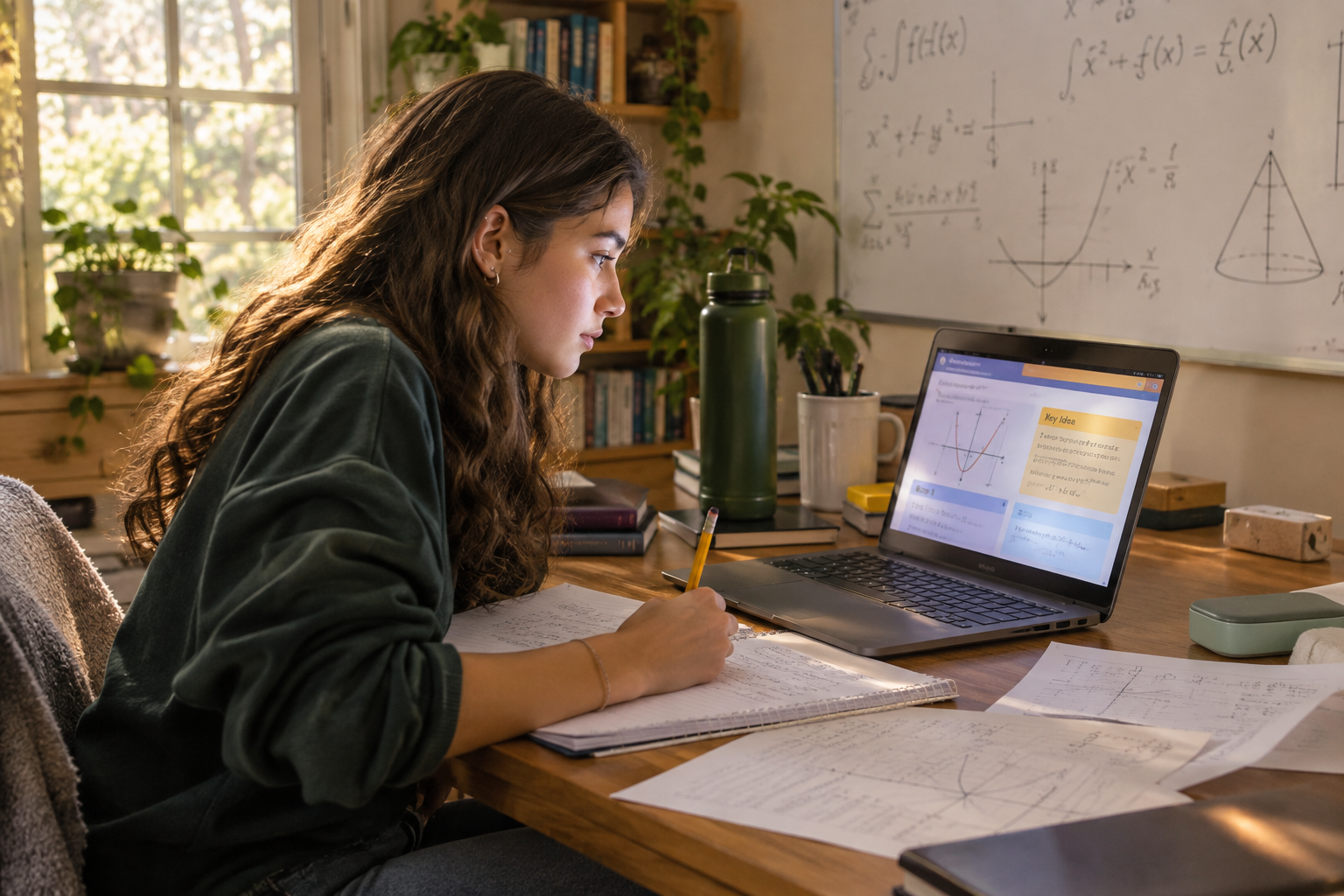
Start with a calculus student and an integral that looks impossible. The mathematics happens when she makes a call: which substitution turns it into something she can solve. Jana Gevertz and Steffen Marcus, mathematicians at The College of New Jersey, use that moment in a guest post on Terence Tao’s blog to separate teaching the concept from teaching the computation. A student who finds the substitution has created the result for herself, they argue. One who blindly follows a computer’s, or even an instructor’s, approach without investigating likely won’t internalize that changing variables is a foundational technique.
Now picture a high school calculus student on a school Chromebook. On Nov. 3, Google said it will switch off Gemini and Google Search for K-12 student accounts unless a district administrator turns them on, Education Week reported. When the AI is on, Google says its search tools will offer “step-by-step guided learning through problems” instead of just handing over answers. That beats the status quo: in July, Common Sense Media reported that Google’s AI Mode fully answered all 180 homework assignments its testers tried.
It still misses something. Work-Generated Learning, the framework we published at Intangled Learning this week, builds on Sfard’s two metaphors for learning. Acquisition treats knowledge as something a person gets and holds. Participation treats learning as a change in how a person takes part in a practice: the calls they make and the responsibility they take on. AI has made answers and explanations nearly free. A guided walk-through is a better way to acquire a solution, but someone has already chosen its route. The framework defines competence as making sound calls in context, and a walk-through can make those calls for the student.
Research mathematicians are living the grown-up version. OpenAI’s early-October release included a claimed proof that Landau–Siegel zeros, hypothetical zeros tied to how primes are distributed that number theorists spent decades trying to rule out, don’t exist. Within weeks, mathematicians were racing to simplify the proof, Quanta reported. Oxford’s Ben Green got his reformulation, which Terence Tao praised, through conversations with OpenAI’s Astra model, and he says “no human originality is claimed.” Others used Astra and Anthropic’s Opus 5.5 to tweak it further, and Cambridge undergraduate Kevin Barreto’s version runs three pages. The contest appears to be shifting from who’s first to who’s simplest, and much of the simplifying is machine-assisted. People still supply the aim, like Barreto’s push for more elementary, classical tools, and judge which version is clearest.
In another guest post on Tao’s blog about writing research, the University of Chicago’s Frank Calegari puts it plainly: “Choosing worthwhile problems may end up mattering more than producing proofs.” He would give substantial credit to someone who picks a worthwhile problem, gets the proof entirely from AI, understands it deeply, and builds new questions from it. Choosing the problem and building on it are participation, not acquisition. He adds that students still need to learn deep mathematics without AI.
Here’s my position. Math class should lead with participation and phase in acquisition on purpose, as our framework recommends. Treat students the way Work-Generated Learning treats apprentices: as researchers of the practice. Every unit should include problems students choose, paths they find without a guide, and machine-made solutions they have to judge. Ask what a less experienced solver would have missed. Then grade the calls, guided by the framework’s question for assessment: “How has this person’s participation in practice changed?”
And it has to be every student. When the testing company NWEA analyzed MAP Growth math scores for nearly 1 million students, only 20% of low-income kindergartners who scored at or above the 95th percentile were still there by 4th grade, compared with 41% of higher-income peers, Education Week reported. Most who slipped still tested in the top 10 or 20 percent of their class, and the report doesn’t establish why. Sfard warned that acquisition invites sorting people by measured potential, while participation describes what people do instead of labeling them. So ask what each student gets the chance to do.
The strongest objection is that this gets learning backward. Beginners learn from worked examples, and an influential line of cognitive science research holds that minimally guided discovery overloads novices. You can’t spot a substitution you’ve never seen, or choose a worthwhile problem without knowing a lot of mathematics. Gevertz and Marcus themselves want to keep the procedural fluency students need to analyze arguments. Our framework agrees: it adds inquiry and evidence of changing participation to instruction and assessment rather than replacing them, and Sfard warned that giving up either metaphor could have grave consequences.
The objection is right about the floor. Worked examples and fluency belong in every math class. But a scaffold is supposed to come down, and as Dr. Wenger argued, learning can’t be designed, only designed for. The danger isn’t step-by-step help but a default in which every problem arrives with its path already found, so students practice following and never practice finding.
Google’s new settings arrive early next year, and Gevertz and Marcus warn that departments may wait years. The hard part is the trade: class time and grades are finite, and every hour spent finding a path by hand is an hour not spent choosing problems, explaining a machine’s solution, or catching its mistakes. When AI can find the path, what should math class reward?
The five
- [News] Education Week: Google’s New Rules Hand Schools Hard Choices About AI and Search
Google will switch off Gemini and Google Search for K-12 student accounts unless a district administrator turns them on, settings can differ by grade, and there will be no Search without AI summaries. Before the changes start early next year, math teachers should help decide which students get Search with AI summaries, which get Gemini, and which get neither. - [News] Quanta’s Transformation: Mathematicians race to simplify AI proofs
After OpenAI claimed a proof that Landau–Siegel zeros don’t exist, mathematicians appear to be competing for the shortest, simplest version, some with help from OpenAI’s Astra and Anthropic’s Opus 5.5. UNSW Canberra’s Bryce Kerr asks AI for the big picture, then tries to fill in the details himself (“I generally won’t read AI papers directly”), a fair model for how students might read machine-made math. - [Essay] Terence Tao’s blog: Mathematics has changed. Let’s act like it.
University of Chicago mathematician Frank Calegari calls OpenAI’s Oct. 6 release of more than 700 papers “a watershed in the history of mathematics” and argues against rewarding a paper purely for a result a machine could produce. If research credit shifts toward choosing problems and building on them, students need practice at that, not just at producing answers. - [Essay] Terence Tao’s blog: What should we teach our (undergraduate) students?
Jana Gevertz and Steffen Marcus of The College of New Jersey ask whether proof courses should add Lean, a programming language for machine-checked proofs, and whether to cut topics to make room for reading and interpreting AI output. Departments may be tempted to wait years, they warn, but anyone teaching calculus or proof this year is already making these choices, deliberately or not. - [Research] Education Week: Low-Income Students Less Likely to Remain in Top Tier for Math
In the testing company NWEA’s analysis of MAP Growth math scores for nearly 1 million students, low-income students were half of all students in 2025 but a fifth of those at or above the 95th percentile. Of 23 states with new math laws or policies since 2022, 14 call for early math assessments but fewer call for acceleration; ask whether your screener can find strong students, too.
This week’s question:
When AI can find the path, what should math class reward? Vote and tell us about one assignment where your students had to make the call instead of following the steps, in the Dispatch channel of our Skool community: [Skool]. Got a read that belongs in next week’s five? Bring it there.
About the Creative Force Dispatch
The Creative Force Dispatch is a weekly reading list from Intangled Learning for teachers, researchers, and practitioners, covering mathematics, mathematics education, AI in education, and technology in education. It’s edited by Dr. Kevin Berkopes, PhD, co-founder and CEO of Intangled Learning, who has spent more than twenty years in mathematics and mathematics education.

